Should a cleaning contractor add a payload to a locally sourced DJI Matrice 400, or buy a purpose-built complete facade cleaning drone?
The answer depends on the buyer’s existing aircraft, target projects, working height, ground workflow, local support and preferred level of system integration. A payload kit and a complete cleaning drone solve related problems, but they are not the same product.
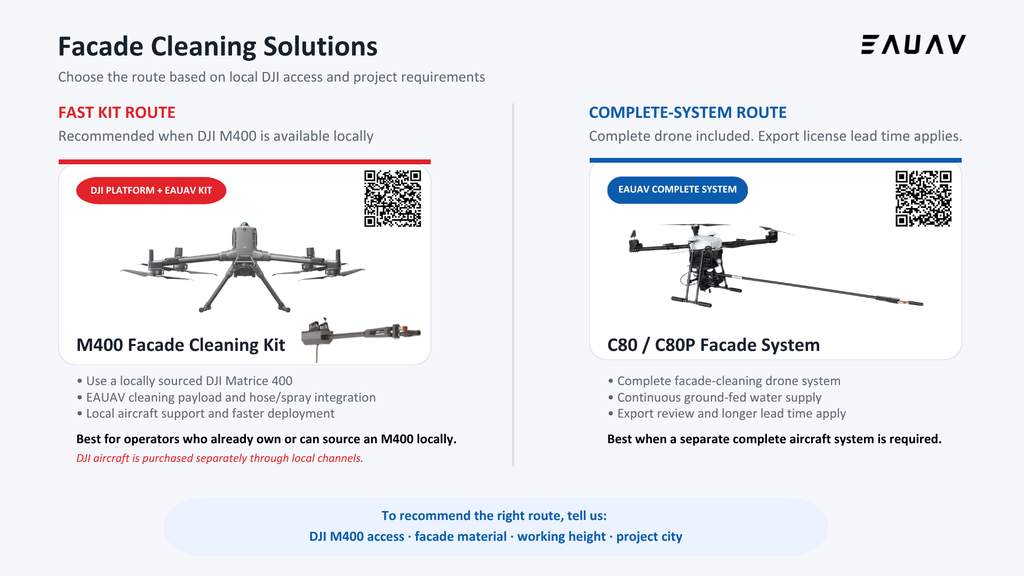
This guide compares the EAUAV DJI M400 Facade Cleaning Kit with EAUAV’s C80/C80P complete-system path without assuming that one is automatically better for every buyer.
The Short Decision
Choose the M400 kit path when:
- You already own or can purchase a DJI Matrice 400 locally
- Familiar DJI controller operation and local aircraft support matter
- Routine facade work is planned below 60 m
- You want a modular airborne cleaning payload
- You can configure a compatible pump and ground workflow
Compare a complete cleaning drone when:
- You prefer a dedicated cleaning platform supplied as a complete system
- The project falls outside the routine M400 working envelope
- Integrated system ownership is more important than using a locally purchased M400
- Your logistics, service model or site conditions favor a purpose-built platform
Final selection must be based on current quoted specifications, the destination and the actual project—not on a generic height or price claim.
What Is the DJI M400 Cleaning Kit?
The M400 kit is an EAUAV cleaning payload and water-delivery configuration designed for the DJI Matrice 400. The standard kit supply does not include the aircraft, original DJI controller, TB100 batteries or BS100 charging station unless these are explicitly listed in the quotation.
The current configuration family is:
- Option A1: Single-Nozzle Kit; lower-entry-cost validation route
- Option A2: Dual-Nozzle Kit; recommended commercial starting point
- Option B: A2 + Kärcher HD 6/15-4 M Classic standalone pump
- Option C: A2 + white Gen-2 Integrated Ground System
Electrical power tethering and Option D are not part of the current offer.
What Is a Complete Cleaning Drone?
A complete cleaning drone is sold around a dedicated aircraft platform and its matched cleaning-system architecture. It may be the more suitable purchasing model when the buyer does not want to source the aircraft locally or needs a dedicated platform for projects outside the routine M400 plan.
For EAUAV, the current C80/C80P product family is the comparison route. Exact aircraft, ground-system, battery, hose, working-envelope, shipping and destination specifications should be taken from the current product page and formal quotation. Do not copy old lead-time, export or regulatory statements into sales content without re-verification.
Comparison by Commercial Decision
| Decision factor | DJI M400 Cleaning Kit | Complete C80/C80P path |
|---|---|---|
| Aircraft | Customer owns or sources DJI Matrice 400 unless specifically quoted | Dedicated aircraft included according to current configuration |
| Controller experience | DJI controller workflow | Platform-specific complete-system workflow |
| Airborne options | A1 or A2; A2 recommended | Confirm current complete-system payload configuration |
| Ground equipment | Local approved pump, Option B or Option C | Confirm current matched ground-system scope |
| Routine height planning | Below 60 m, subject to site review and validation | Evaluate for taller or dedicated-system projects using current specifications |
| Standard M400 hose reference | 120 m, 5 mm ID, 20 MPa; not equal to working height | Confirm current hose and working-envelope data |
| Local aircraft service | May benefit from local DJI Enterprise access | Depends on complete-system service arrangement |
| Shipment scope | Kit/components can be separated from locally sourced aircraft | Larger complete-system shipment |
| Best-fit buyer | Existing/new local M400 owner adding cleaning capability | Buyer seeking a dedicated cleaning platform |
Why A2 Is the Recommended M400 Starting Point
Option A1 uses one nozzle at a time. For a foam-to-rinse workflow, the aircraft lands so the crew can change the nozzle manually before the rinse flight.
Option A2 uses two spray heads. The pilot can select the active head from the DJI controller without landing solely for a nozzle exchange. The result is a more fluent commercial workflow and a stronger customer demonstration.
A2 controls which spray head is active. It does not automatically switch the ground liquid source. The ground crew must change water/detergent mode according to the confirmed pump setup.
Ground-System Choices Change the Buying Decision
Existing or Locally Purchased Pump
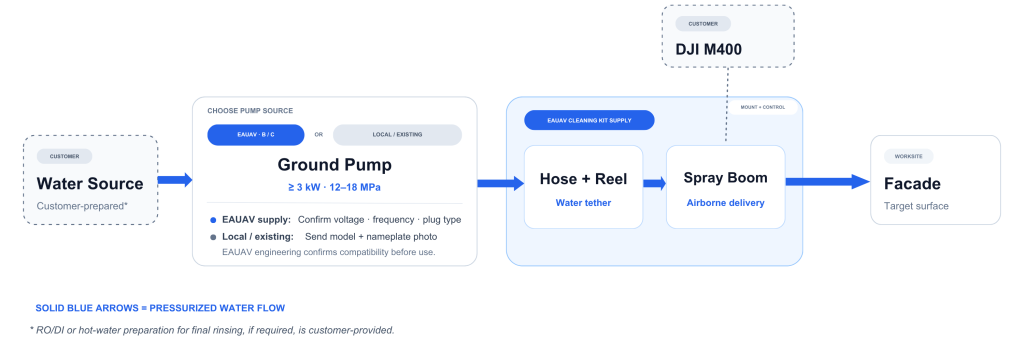
This is attractive when the buyer has local service access and wants to reduce international freight. Initial screening requirements are:
- At least approximately 3 kW
- Adjustable 12–18 MPa pressure
- Approximately 450–600 L/h flow
Send the exact model, nameplate and outlet photos for EAUAV engineering approval.
Option B — Matched Standalone Pump
Option B adds the Kärcher HD 6/15-4 M Classic to A2. Reference data: adjustable 70–150 bar, approximately 450–600 L/h and 3.4 kW.
It is the straightforward EAUAV-supplied pump path. The customer still prepares the water source and any required RO/DI or hot-water equipment.
Option C — Integrated White Ground System
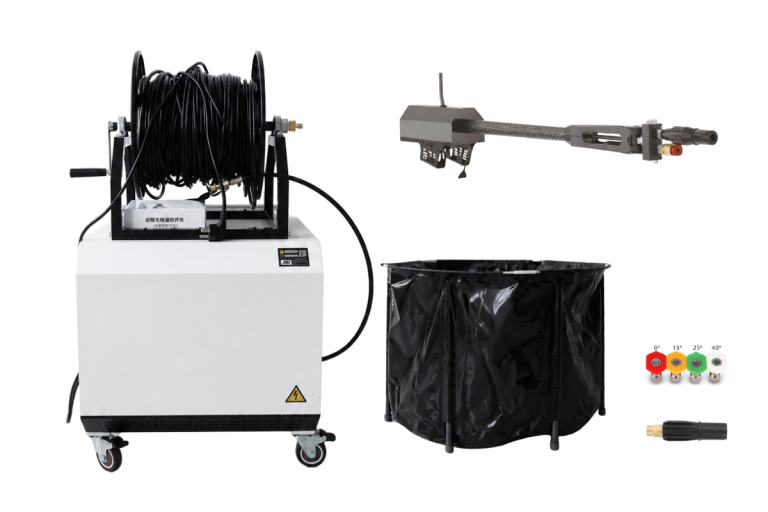
Option C adds the Gen-2 Integrated Ground System to A2. The reference configuration includes up to 15 MPa, up to 11 L/min, approximately 3.3 kW, 300 L foldable water tank, 10 L detergent tank, integrated reel, remote start and water/mixed-mode workflow.
Option C does not manufacture RO/DI water and does not heat water.
For Option B or C, destination voltage, frequency, phase, plug and socket must be confirmed before quotation.
Height, Hose and Surface Suitability
The M400’s standard 120 m hose is a component length, not a promise of 120 m vertical cleaning height. Part remains on the ground; bends, routing, horizontal offset and safety allowance use additional length. The airborne hose creates changing mass and drag.
EAUAV therefore uses below 60 m as the routine M400 facade-planning range. Begin a low-height surface test at approximately 1.5 m stand-off from a flat facade, then validate pressure, pattern, hose behavior and surface response.
A taller nominal system is not automatically the correct choice either. Building shape, wind, water supply, surface, runoff, ground footprint, crew and local rules still determine usability.
Flight Time and Jobsite Continuity
DJI publishes up to 59 minutes maximum flight time under its specified test conditions carrying the H30T. For operation with the cleaning spray boom and water hose, EAUAV uses approximately 30 minutes per cleaning flight as a planning reference, subject to site conditions.
The recommended M400 jobsite plan is three TB100 batteries:
- One in flight
- One charging
- One cooled, checked and ready on standby
This replaces the former electrical power-tether concept. Actual rotation depends on charging power, battery condition, temperature and required reserve.
Local Availability and Support
If the customer can buy the DJI M400 locally, the kit route may simplify aircraft procurement, training and service. Before deciding, confirm:
- Whether the local DJI Enterprise channel supplies and supports M400
- Aircraft, controller, battery and charger availability
- Who supports the cleaning payload and ground system
- Spare fittings, nozzles and hoses required onsite
- Import and electrical requirements for the selected EAUAV components
EAUAV also supports channel discussions with DJI Enterprise dealers, distributors, integrators and cleaning-service partners. Product testing and cooperation discussions are underway in more than 10 countries. This does not mean every discussion partner is an appointed or exclusive distributor.
Regulatory and Commercial Claims Must Be Destination-Specific
Drone, worksite, chemical, water-discharge and import requirements change by country and over time. The operator and importer remain responsible for current local compliance.
Avoid fixed statements such as “no license is required,” universal approval timelines or permanent export assumptions. Link to the relevant official authority and add a review date whenever country-specific guidance is published.
A Practical Selection Checklist
Select the M400 kit for evaluation if:
- A locally supported M400 is available
- The intended facade work is routinely below 60 m
- A non-contact cleaning test is appropriate
- The crew can manage pump, hose, batteries and exclusion zone
- A1/A2/B/C provides a clear commercial path
Compare the complete-system path if:
- A dedicated cleaning aircraft is preferred
- The current M400 planning range does not fit
- Local M400 procurement or support is impractical
- A complete-system ownership model is commercially clearer
Request engineering review before purchase if:
- You plan to use your own pump
- The facade has complex recesses, setbacks or wind exposure
- The desired result requires chemicals, hot water or RO/DI final rinse
- The project height is near or outside the routine M400 planning range
- Local electrical or connector details are uncertain
Information Needed for a Useful Comparison
- Country, city and postal code
- Buyer type and company website
- M400 ownership or local sourcing status
- Building height, facade photos and project location
- Surface and contamination
- Preferred airborne option: A1, A2 or Not sure
- Preferred ground route: local pump, B, C or Not sure
- Existing pump model/nameplate/outlet photos
- Water source and RO/DI/hot-water requirements
- Voltage, frequency, phase, plug and socket
- Quantity and target project date
Review the current DJI M400 Facade Cleaning Kit and send the project details for a configuration comparison.
Related Reading
- M400 Facade Cleaning Kit Options
- How High Can DJI M400 Clean Facades?
- Drone Facade Cleaning vs Rope Access and Boom Lifts
FAQ
Is a DJI Matrice 400 included in the M400 cleaning kit?
No. It is a cleaning-payload and water-delivery configuration for M400 unless the quotation explicitly includes the aircraft and DJI accessories.
Is A2 better than A1?
A2 is the recommended commercial workflow because the pilot can select the active spray head from the controller. A1 remains useful for lower-cost validation and simple tasks.
Is Option B the recommended starting point?
A2 is the recommended airborne starting point. Option B is A2 plus the matched Kärcher pump; choose it if that ground-pump supply fits the project.
Is there an Option D or power-tether package?
No. Current customer-facing options are A1, A2, B and C. EAUAV recommends three TB100 batteries for rotation.
Does the 120 m hose provide 120 m working height?
No. Routine M400 facade planning is below 60 m, and actual height requires site review and progressive validation.