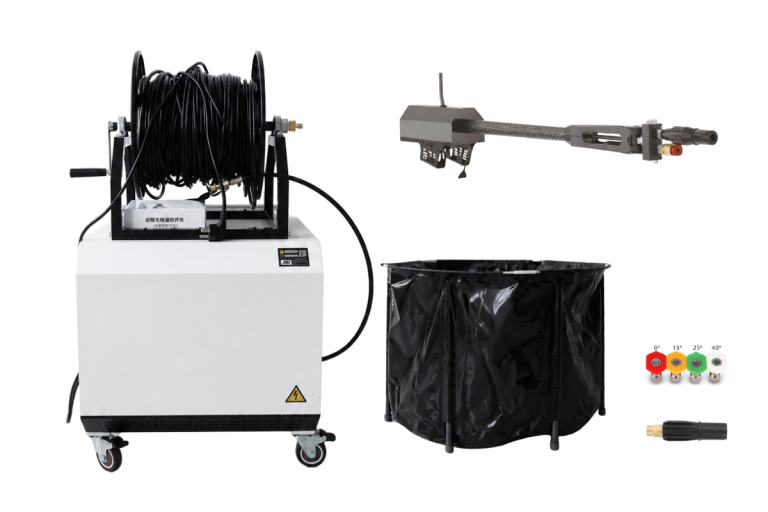
When buyers compare DJI M400 cleaning payloads, they often focus on the visible hardware: the spray boom, nozzle, hose and pump. Those components matter, but the control workflow also affects pilot workload, training and how easily a dealer can demonstrate the system.
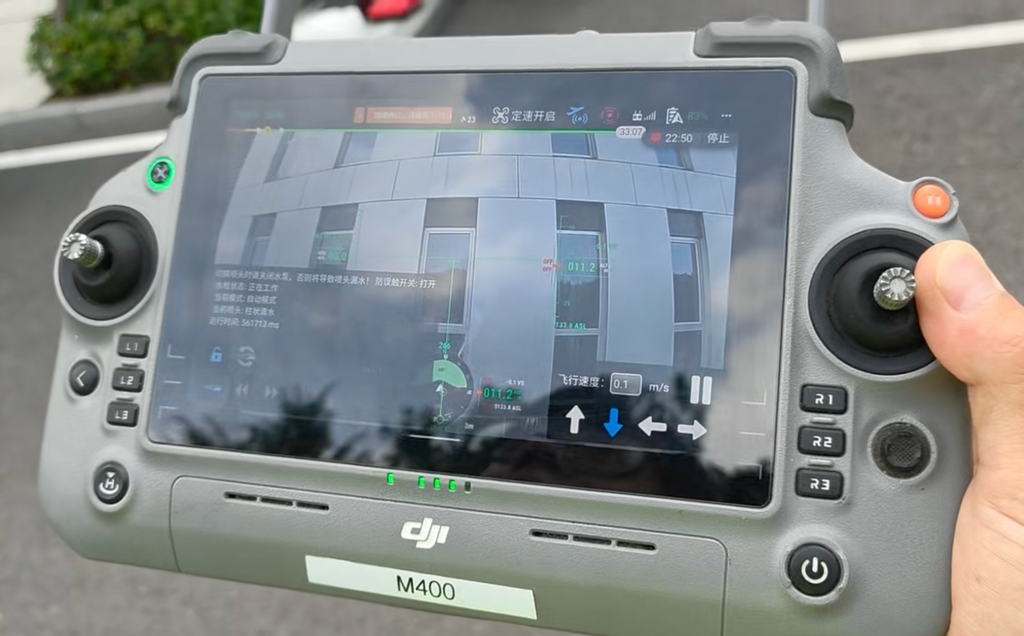
Quick answer: the EAUAV M400 Facade Cleaning Kit is designed around DJI PSDK and E-Port V2 so supported airborne cleaning functions remain within a DJI-centered controller workflow. Option A1 provides controller-based payload operation with a single spray head. Recommended Option A2 adds controller-based selection between its two spray heads, avoiding a landing solely to change the nozzle.
This does not mean every ground-pump or liquid-source function is automatically controlled by the DJI controller. Ground-pump start/stop and water/mixed-mode selection depend on the quoted ground configuration and confirmed interface.
Who This Guide Is For
This guide is useful for:
- DJI Enterprise dealers evaluating an M400 cleaning application;
- existing DJI Matrice 400 operators;
- facade-cleaning contractors comparing payload workflows;
- distributors preparing a repeatable customer demonstration;
- technical buyers comparing an integrated payload workflow with a basic add-on spray remote.
What PSDK and E-Port V2 Mean
DJI PSDK is DJI’s Payload Software Development Kit. E-Port V2 is the payload interface used by the DJI Matrice 400.
In practical terms, the EAUAV kit is designed to connect through the M400 payload interface and place supported payload functions within the original DJI controller environment. The operator does not need to treat the cleaning boom as an entirely isolated accessory.
PSDK integration does not mean DJI manufactures, sells, approves or warrants the EAUAV cleaning kit. EAUAV is responsible for the cleaning payload, its documentation and its support scope. DJI aircraft warranty interpretation remains with DJI and the local authorized channel.
What the DJI Controller Can Operate
The exact functions depend on the selected configuration.
Option A1
Option A1 is the lower-entry-cost single-nozzle kit. The payload connects through the M400 interface and supports the configured boom workflow. When a foam-to-rinse job requires a different nozzle, the operator lands the aircraft, changes the nozzle on the ground and relaunches for the rinse.
Typical A1 workflow:
Foam → Land → Change Nozzle → Relaunch → Rinse
Option A2 — Recommended
Option A2 uses a dual-nozzle boom. The operator can select the active foam or pressure-rinse spray head from the DJI controller without landing solely to change the nozzle.
Typical A2 airborne workflow:
Foam → Select Spray Head on DJI Controller → Rinse
The controller changes the active spray head. It does not, by itself, change the ground-side liquid from detergent solution to clean water. The ground crew or confirmed ground system must also change the liquid source when the cleaning process requires it.
Where Ground-Pump Control Fits
The ground system is a separate part of the cleaning architecture:
Customer-prepared water source → Ground pump → Lightweight high-pressure hose → M400 spray boom → Target surface
EAUAV offers three ground-pump routes:
- Use an existing or locally purchased pump after EAUAV engineering review.
- Select Option B with the Kärcher HD 6/15-4 M Classic matched standalone pump.
- Select Option C with the white Gen-2 Integrated Ground System.
Remote pump start/stop or water/mixed-mode selection is available only where the selected ground system and interface support it. A local pump should not be assumed to support DJI-controller operation.
Why a Separate Spray Remote Can Add Complexity
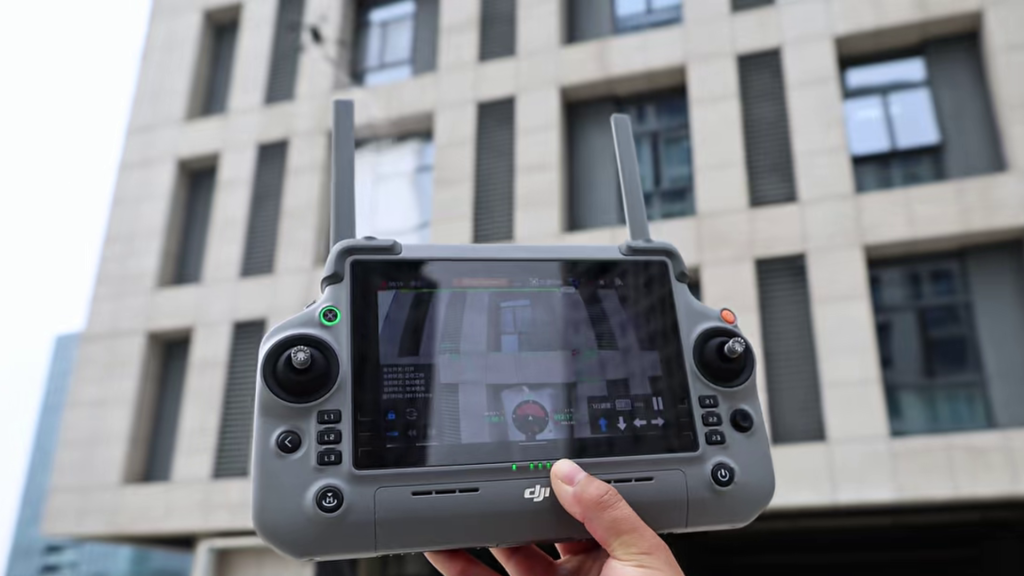
Some basic cleaning kits use another handheld controller for spray on/off, pump control or nozzle functions. This may be acceptable for an early controlled test, but it adds another control layer.
The project team must then decide:
- whether the pilot or a ground assistant holds the second remote;
- how pilot and pump operator coordinate each spray command;
- how emergency shutdown is handled;
- how the workflow will be taught to multiple operators;
- whether a dealer can repeat the same demonstration reliably.
A separate remote is not automatically unsafe or unsuitable. The issue is that its additional control layer must be managed in the SOP and crew communication plan.
Practical Comparison
| Decision factor | PSDK / DJI-centered payload workflow | Separate spray remote |
|---|---|---|
| Pilot interface | Supported functions remain closer to the M400 controller workflow | Adds another device and control logic |
| A2 spray-head selection | Selected from the DJI controller | Depends on the third-party system |
| Dealer demonstration | More consistent for existing DJI customers | Requires explanation and training for another device |
| Crew coordination | Fewer airborne control layers | May require tighter pilot/ground-operator coordination |
| Ground-pump control | Configuration-dependent; must be confirmed | Configuration-dependent; must be confirmed |
| Training | Can be standardized around the quoted EAUAV configuration | Depends heavily on the remote and supplier |
Questions to Ask Before Ordering
Ask the payload supplier:
- Does the payload connect through DJI E-Port V2?
- Which functions are actually available in the DJI controller?
- Does nozzle selection also change the ground liquid source?
- How is the ground pump started and stopped?
- Is a separate remote or ground control box required?
- What happens during an emergency stop?
- Is the workflow documented in the installation guide and SOP?
- Can the supplier review an existing or locally purchased pump?
FAQ
Does PSDK mean DJI manufactures the cleaning kit?
No. The EAUAV kit is a third-party payload designed around DJI PSDK / E-Port V2. DJI does not manufacture the EAUAV cleaning kit.
Can A2 change from foam to pressure rinse without landing?
A2 can select the active spray head from the M400 controller without landing solely for a nozzle change. The ground-side liquid source must still be changed separately unless the confirmed ground configuration supports water/mixed-mode switching.
Can any local pump be controlled from the DJI controller?
No. Local-pump compatibility and control functions must be reviewed. Send EAUAV the exact model, nameplate, rated power, pressure, flow and outlet photos before connecting it to the kit.
Is a separate spray remote always the wrong choice?
No. It may be acceptable for a basic controlled test. Commercial operators should account for the additional device in training, communication and emergency procedures.
Does the DJI-centered workflow replace safety planning?
No. Operators still need site assessment, hose routing, pump procedures, exclusion zones, crew communication, emergency planning and local approvals.
Conclusion
The M400 cleaning payload is more than a spray boom. The control architecture affects how the system is demonstrated, trained and operated.
Option A1 provides the lower-cost manual nozzle-change route. Option A2 is EAUAV’s recommended commercial starting point because the operator can select its two spray heads from the DJI controller without landing solely to change the nozzle. Ground-pump and liquid-source controls remain configuration-dependent and must be confirmed before quotation.
View the DJI M400 Facade Cleaning Kit and select A1, recommended A2, B or C.