If you are evaluating a fertilizer spreading drone, a drone for seeding, or a topdressing drone, the first question is usually about payload. That matters, but it is not the question that usually decides long-term fit. The more useful question is whether the platform can keep granular materials moving in a controlled way, reduce unnecessary loading stops, and show the operator what is actually happening during the job.
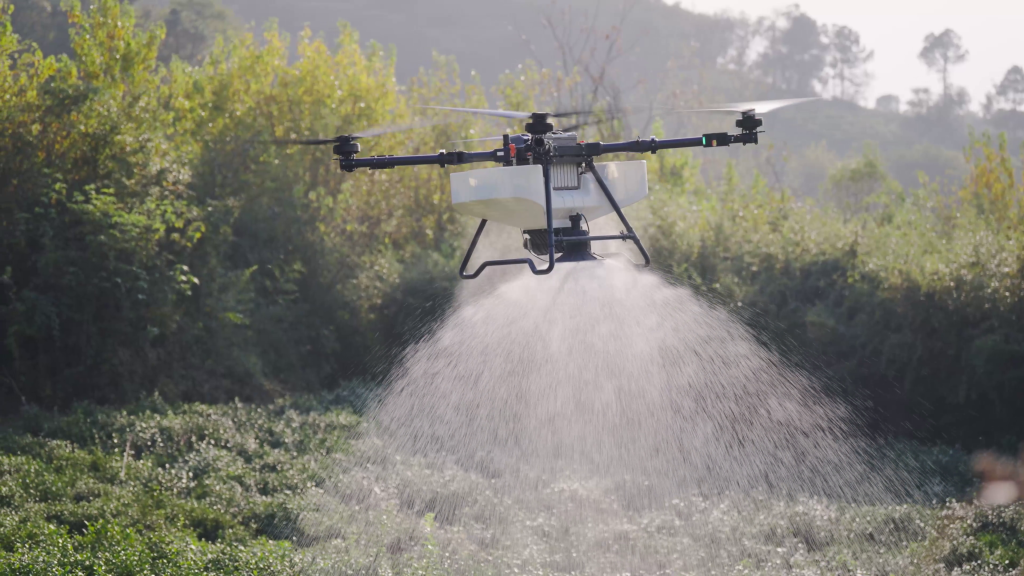
The A80 is a heavy-lift, modular agricultural drone platform built for spraying, fertilizer spreading, seeding, and precision payload delivery. In its spreading and seeding configuration, it uses a 150 L hopper, carries up to 80 kg max payload, supports up to 400 kg/min max feeding rate, works up to 10 m max spreading width, and combines metered auger feeding with centrifugal distribution. It also supports ultra-low application rates, offers multiple auger feeder types, and provides real-time weighing with visualized data.
That makes the A80 worth evaluating as an agricultural spreader drone for commercial work. It does not mean it is right for every task or every material. This guide focuses on honest fit: where the A80 is strong, what should still be validated on site, and why capacity plus controlled metering plus weighing matters more than brochure claims alone.
Why spreading and seeding are not the same job
Spreading and seeding are both granular tasks, but they do not ask the same things from the machine.
Base fertilizer and topdressing usually put more weight on loading rhythm, stable feed behavior, and enough output headroom to keep the day moving. Seed spreading often puts more pressure on feeder selection, lower-rate control, and how the specific seed behaves in the system. The same airframe can support both categories, but buyers should not assume one default setup is equally good for every material.
That is why a practical agricultural spreader drone is judged less by max payload alone and more by whether its feeding system can be matched to the task. If you are comparing one auger feeder spreader drone to another, the real questions are straightforward: how is the material metered, how adaptable is the feeder configuration, and how clearly can the crew monitor actual usage while working?
Common use cases
Base fertilizer
If you are evaluating the A80 as a base fertilizer drone, the first advantage is operational rhythm. A 150 L hopper and up to 80 kg max payload reduce how often the crew has to stop and reload. That matters in commercial work because repeated loading interruptions can become the real bottleneck.
The second advantage is that the system is built around metered auger feeding rather than a vague open-gate concept. For free-flowing base fertilizer, that is the kind of control buyers should look for first.
Topdressing
As a topdressing drone, the A80 is strongest where teams need both output headroom and controlled delivery. Up to 400 kg/min max feeding rate gives the platform a high-output ceiling, while ultra-low application rates are also supported. That range matters because not every topdressing task is the same.
In practice, useful fit is not about one maximum figure. It is about whether the platform can handle both heavier-output and lower-output granular work without forcing the operator into one fixed operating style.
Seed spreading
For drone seeding, the key question is not simply whether the seed fits in the hopper. The real question is whether the seed behaves well enough in the feeding system and whether the feeder type suits the material.
The A80 supports seed spreading and offers multiple auger feeder types, which makes it more adaptable than a one-feeder-only concept. But this is exactly the category where honest fit matters most. Some seed types are straightforward. Others deserve testing before a buyer scales up.
Other granular inputs
The A80 also fits other granular inputs when they are free-flowing and predictable. That makes it relevant for service providers who want one platform that can cover more than one type of granular task.
The important point is what not to claim. The A80 should be positioned as a strong option for base fertilizer, topdressing, seed spreading, and other granular inputs. It should not be marketed as universally compatible with every material that happens to come in a bag.
What makes a drone spreader practical in real work
Loading frequency
A large part of real productivity has nothing to do with the aircraft in the air. It comes from what happens on the ground between flights.
When the hopper is too small, crews lose time to repeated loading cycles. A 150 L hopper does not solve field organization by itself, but it changes the working rhythm in a meaningful way. For commercial operators, that often matters more than a single peak-rate claim.
Feed consistency
Granular work is not just about moving material out of the hopper. It is about moving it in a controlled way.
Metered auger feeding matters because inconsistent flow creates uncertainty quickly. That is true in fertilizer work and even more true when different materials or feeder setups are involved. A good spreader system should help the crew pursue more repeatable delivery instead of leaving the result to gravity and guesswork.
Output control
Useful output control means having room at both ends of the job.
The A80 supports up to 400 kg/min max feeding rate, up to 10 m max spreading width, and ultra-low application rates. That combination matters because some operations need throughput headroom, while others are evaluating the platform for ultra-low application rate work. A buyer should evaluate that range, not just the top-end number.
Confirmation of material usage
A surprising amount of field uncertainty comes from not knowing clearly how much material is actually moving through the task.
That is why confirmation of material usage matters so much. Real-time weighing with visualized data gives the crew a more grounded view of remaining material and refill timing, instead of relying only on estimation.
How A80 supports these jobs
The A80 supports spreading and seeding as a system, not just as a large hopper attached to a drone.
Its 150 L hopper and up to 80 kg max payload address one of the biggest commercial issues in granular work: too much stop-start loading. Its up to 400 kg/min max feeding rate gives high-output headroom when the task demands it. Its up to 10 m max spreading width gives a working-width ceiling that can be matched to the actual job rather than treated as a fixed assumption.
Just as important, the feeding architecture is deliberate. The A80 uses metered auger feeding and centrifugal distribution, supports ultra-low application rates, and offers multiple auger feeder types. That combination matters because real material behavior changes from task to task. The platform is better judged as a configurable granular-work system rather than a one-setting machine.
Best-fit materials include base fertilizer, topdressing, seed spreading, and other granular inputs. That is the right fit zone to focus on. It is also the right place to stop before overclaiming.
Why real-time weighing matters for service providers, reporting, and operational control
Service providers
For service providers, real-time weighing with visualized data helps turn a spreading task into a more controlled service workflow. It makes it easier to judge refill timing, reduce rough end-of-task estimation, and manage multiple jobs with clearer material visibility.
Reporting
Customers and internal managers often ask the same question after the job: how much material was actually used?
Real-time weighing does not replace the operator’s own job records, but it gives those records a stronger operational basis. That matters for teams that need more credible service documentation rather than informal estimates written down afterward.
Operational control
Operational control is where weighing becomes especially valuable. If material usage starts drifting from expectation, the crew has a better chance of seeing it during the job instead of after the fact. That helps teams check feeder choice, loading practice, and material behavior sooner.
For procurement teams, this is one of the clearest differences between a brochure-friendly machine and a commercially useful one.
Materials and conditions that should be checked before ordering
This is the section buyers should pay closest attention to.
The A80 is a strong fit for free-flowing granular materials in use cases such as base fertilizer, topdressing, seed spreading, and other granular inputs. But difficult materials should not be waved through just because the hopper is large or the payload number looks strong.
Sticky materials, irregular particle sizes, and non-free-flowing materials should be checked before ordering. Moisture behavior, clumping tendency, particle variability, and bridging risk still matter. Multiple auger feeder types help widen the usable range, but they do not remove the need for material-specific validation.
A large-capacity spreader can still be the wrong choice if the material itself will not move predictably.
A decision matrix for buyers
| Task type | Material type | What A80 is strong at | What needs testing first |
|---|---|---|---|
| Base fertilizer | Free-flowing granules | 150 L hopper, up to 80 kg max payload, metered auger feeding | Particle size range and feeder match |
| Topdressing | Granular topdressing inputs | Up to 400 kg/min max feeding rate, up to 10 m max spreading width, ultra-low application rates supported | Required rate range and material flow stability |
| Seed spreading | Suitable free-flowing seed types | Multiple auger feeder types, metered auger feeding, real-time weighing with visualized data | Seed behavior, feeder choice, and on-site validation |
| Other granular inputs | Predictable free-flowing granules | Heavy-lift platform plus controlled metering and monitored material status | Moisture sensitivity, clumping, and hopper behavior |
| Difficult material scenarios | Sticky, irregular, or non-free-flowing materials | Honest evaluation rather than overclaiming | Full material testing before purchase decision |
When A80 is the right fit — and when it is not
The A80 is the right fit when the operation is commercial enough that loading rhythm, controlled metering, and material visibility matter day after day. It makes the most sense for growers, service providers, distributors, farm managers, and procurement teams who want one heavier-duty platform for base fertilizer, topdressing, seed spreading, and other suitable granular jobs.
It is also a strong fit when the buyer values operational accountability. Real-time weighing with visualized data is not just a convenience feature; it supports clearer refill planning and stronger task records.
The A80 is not the right fit when the buyer expects every granular material to work without testing. It may also be more platform than needed for lighter workloads where a smaller system already meets the task without creating a capacity gap. And it is not the right choice for materials that are sticky, irregular, or non-free-flowing if those behaviors cannot be validated first.
That is the honest answer. The A80 is not a universal answer. It is a strong answer in the right zone.
Talk to EAUAV about your material and workflow
If you are evaluating the A80 as a fertilizer spreading drone, a topdressing drone, or a drone for seeding, the most useful next step is a fit discussion based on your real material and workflow.
Share the material type, particle behavior, target rate range, feeder preference, and service model. From there, EAUAV can help assess whether the A80 is the right commercial fit, what should be tested first, and how the system should be positioned for growers, service providers, or distributor channels.
FAQs
What is the difference between a drone spreader and a seeding drone?
A drone spreader is usually judged on how it handles granular material flow, output control, and loading rhythm. A seeding drone may use the same platform, but it must also be judged by seed behavior, feeder choice, and lower-rate suitability. The A80 can support both, but the setup logic should not be assumed to be identical.
Can one agricultural drone handle topdressing and seed spreading?
Yes. The A80 can support both topdressing and seed spreading. The key point is that one feeder choice or one setting should not be assumed to suit every material. Material-specific validation still matters.
What materials should be tested before using a fertilizer spreading drone?
Sticky materials, irregular particle sizes, and non-free-flowing materials should be tested first. A large hopper and strong payload do not remove material-flow risk.
When is a heavy-lift spreader drone a better fit than a smaller model?
A heavy-lift spreader drone is usually the better fit when the operation values fewer loading interruptions, stronger output headroom, controlled metering, and clearer material tracking across commercial jobs. For lighter workloads, a smaller platform may be enough.
Why does real-time weighing matter in topdressing or seeding work?
Because it helps crews see remaining material more clearly, plan refills with less guesswork, and build more credible job records. It is useful for service delivery, reporting, and day-to-day operational control.
Does a high feeding rate mean the drone suits every granular task?
No. High feeding rate gives output headroom, but real fit still depends on material flow behavior, feeder choice, target rate, and whether the material remains predictable in real conditions.