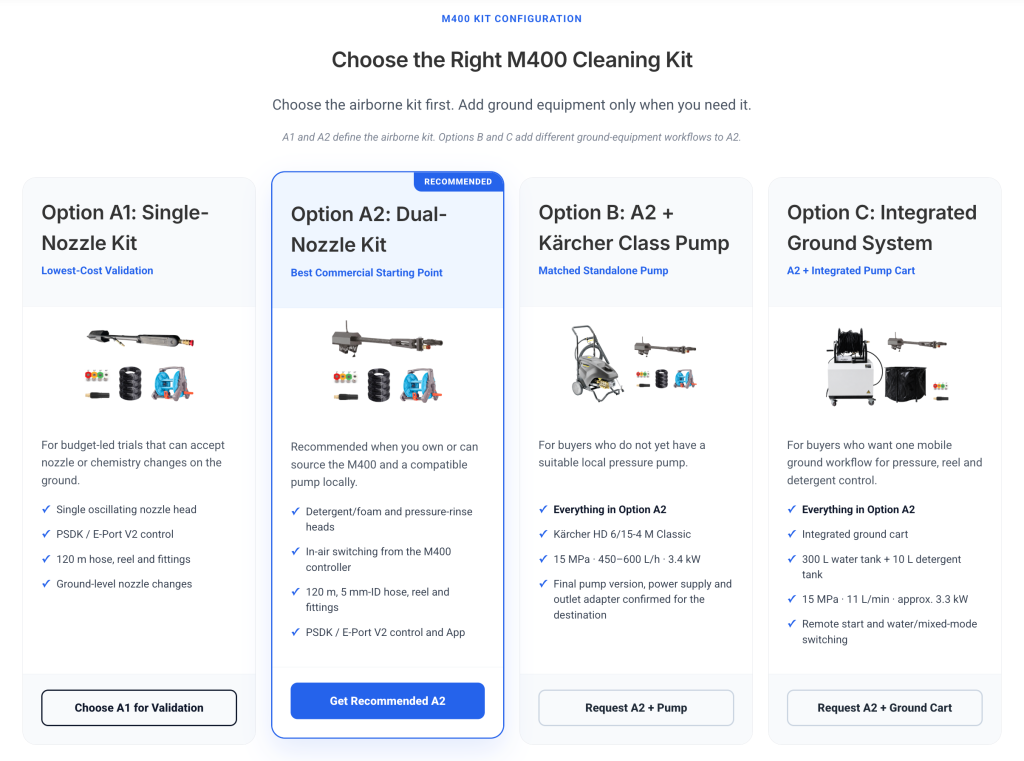
The EAUAV DJI M400 Facade Cleaning Kit is available in four configurations. The correct choice depends on two decisions:
- Do you want the lower-cost single-nozzle A1 workflow or the smoother dual-nozzle A2 workflow?
- Will you use a locally sourced pump, an EAUAV-supplied standalone pump, or the integrated white ground system?
For most commercial facade-cleaning teams, Option A2 is the recommended starting point. Options B and C build on A2 by adding different ground equipment.
DJI Matrice 400 aircraft, original DJI controller, TB100 batteries and BS100 charging station are not included in the standard cleaning-kit supply unless specifically listed in the quotation.
Quick Comparison
| Option | Configuration | Best for | Workflow position |
|---|---|---|---|
| A1 | Single-Nozzle Kit | Lowest-entry-cost technical validation and straightforward spray tasks | Land to change the nozzle between foam and rinse |
| A2 — Recommended | Dual-Nozzle Kit | Commercial operators who want a smoother foam-to-rinse workflow | Select the active spray head from the DJI controller |
| B | A2 + Kärcher HD 6/15-4 M Classic | Customers who need a matched standalone professional pump | A2 airborne workflow plus a compact EAUAV-supplied pump |
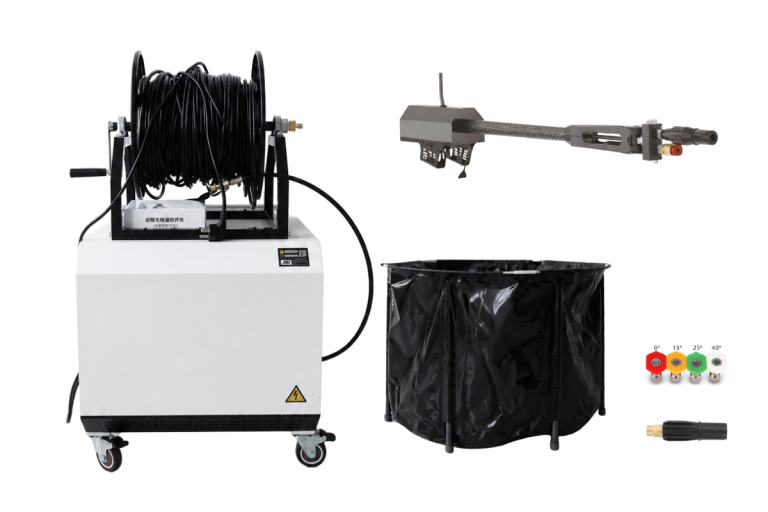
| C | A2 + Gen-2 Integrated Ground System | Teams that want an integrated pump, tank, reel and detergent workflow | Premium ground workflow with the white mobile unit |
There is no electrical power-tether option in the current product range. For cleaning continuity, EAUAV recommends a three-TB100 battery rotation.
Option A1 — Single-Nozzle Kit
Lower-Cost Technical Validation
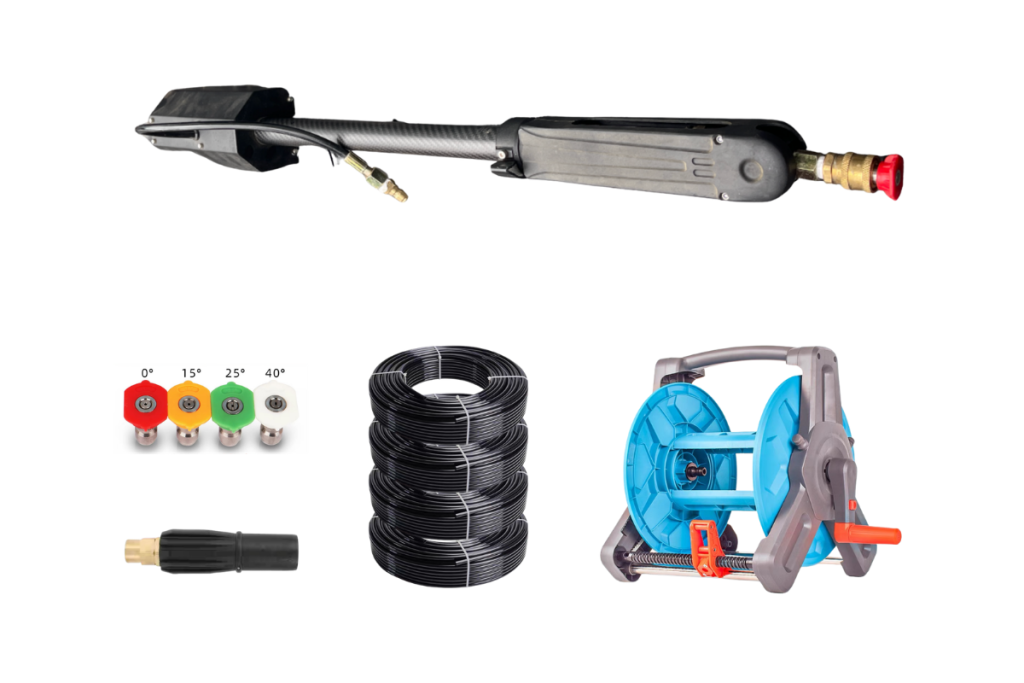
Option A1 is the simplest airborne configuration. It is appropriate when the buyer wants to validate the market at a lower initial equipment cost or primarily expects straightforward water-fed work.
For foam-to-rinse cleaning, the A1 workflow is:
- Take off with the foam nozzle installed.
- Apply foam or cleaning solution.
- Land the aircraft.
- Manually replace the nozzle with the pressure-rinse nozzle.
- Take off again and rinse with clean water.
The required landing and nozzle change add a manual step, but the workflow is easy to understand and keeps the airborne configuration simple.
Choose A1 if:
- Lowest initial kit cost is the priority
- The first goal is technical or market validation
- Most tasks use one spray pattern per flight
- A manual nozzle-change landing is acceptable
Option A2 — Dual-Nozzle Kit
Recommended Commercial Starting Point
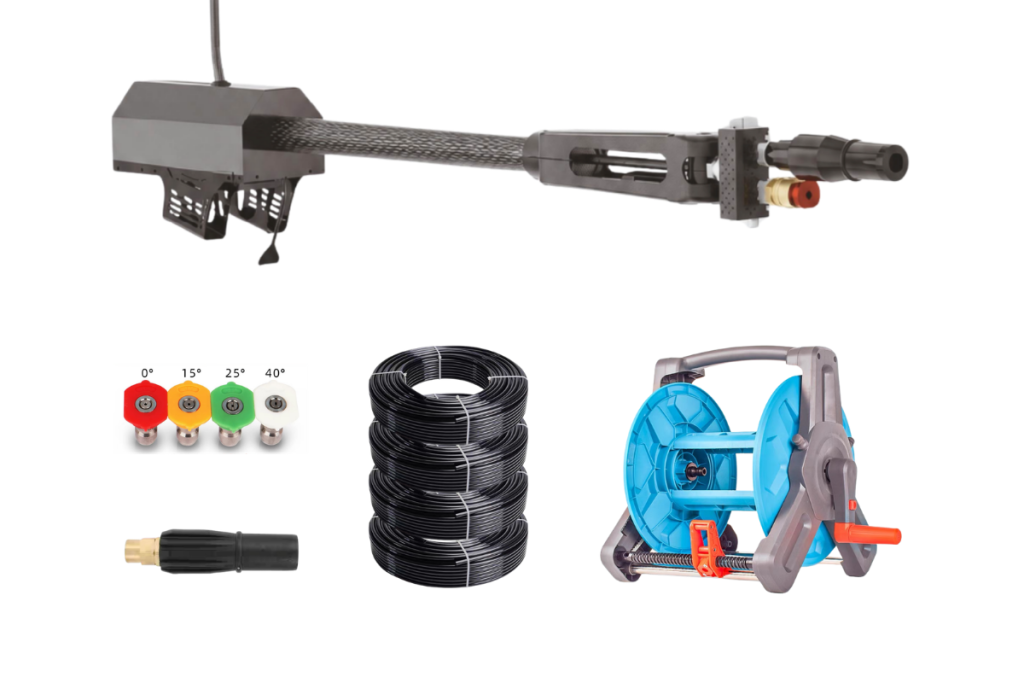
Option A2 adds two spray heads and controller-based selection. The pilot can select the active spray head from the DJI controller, so the aircraft does not need to land solely to exchange the nozzle.
For a foam-to-rinse project, the intended workflow is:
- Apply foam or solution using the selected spray head.
- Select the second spray head from the DJI controller.
- Continue with the pressure-rinse head.
This creates a more fluent operating demonstration and reduces workflow interruption.
Important control boundary
The DJI controller changes the active spray head. It does not automatically replace detergent with clean water at the pump. The ground crew must switch the liquid source or ground mode according to the confirmed pump configuration. Option C supports a ground-side water/mixed-mode workflow; other setups require their own validated liquid-change procedure.
Choose A2 if:
- You are building a recurring commercial service
- Foam-to-rinse workflow matters
- You want fewer landings caused only by nozzle changes
- You need the clearest technology demonstration for customers
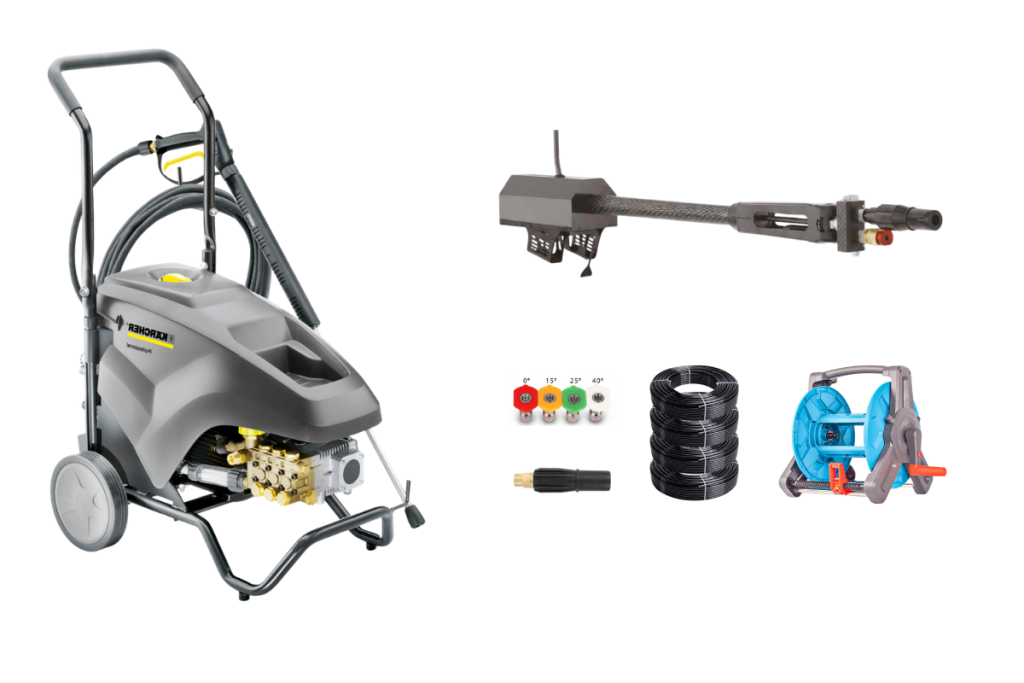
Option B — A2 + Kärcher Standalone Pump
Option B combines the recommended A2 airborne kit with a Kärcher HD 6/15-4 M Classic.
Reference pump data:
- Adjustable working pressure: approximately 70–150 bar
- Flow: approximately 450–600 L/h
- Rated input: 3.4 kW
- Professional standalone format
Option B is the practical choice when the customer wants EAUAV to provide a matched pump but does not need an integrated tank and detergent cart.
Customer-prepared items
- Suitable clean-water supply or tank
- Water-treatment equipment for RO/DI final rinse, when required
- Hot-water preparation equipment, when required
- Appropriate local power outlet and site connection
Electrical details required before quotation
Provide the destination:
- Voltage
- Frequency
- Phase
- Plug type
- Socket/outlet type and photo where possible
The final electrical version and connection must be confirmed before shipment.
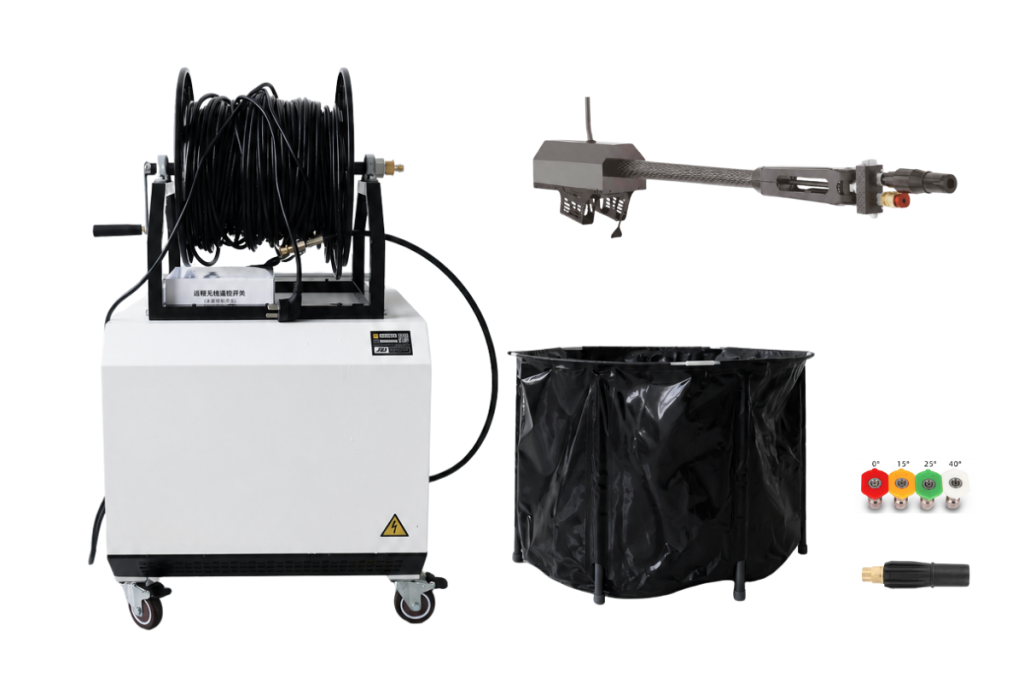
Option C — A2 + Gen-2 Integrated Ground System
Option C combines A2 with the current white Gen-2 Integrated Ground System. This mobile unit is designed to organize the pump, hose reel and water/detergent workflow in one ground platform.
Current reference configuration:
- Up to 15 MPa pressure
- Up to 11 L/min flow
- Approximately 3.3 kW
- 300 L foldable water tank
- 10 L detergent tank
- Integrated hose reel
- Remote start
- Water and mixed-mode ground workflow
Option C is intended for teams that value jobsite organization and a more complete foam-to-rinse ground process.
What Option C does not include
Option C does not create RO/DI water and does not heat water. If spot-free final rinsing or hot-water treatment is needed, the customer must prepare compatible equipment and validate the complete water path.
The destination voltage, frequency, phase, plug and socket must be confirmed before quotation.
Can I Use My Own or a Locally Purchased Pump?
Yes, subject to engineering confirmation.
Initial screening baseline:
- At least approximately 3 kW
- Adjustable pressure from 12 to 18 MPa
- Approximately 450–600 L/h flow
Send EAUAV:
- Exact manufacturer and model
- Clear nameplate photo
- Pump outlet and fitting photos
- Technical data sheet, if available
- Destination country and local power details
- Planned hose length and cleaning height
EAUAV engineering will review the pump and connection. A pump is not automatically approved merely because its rated pressure falls within the range.
Hose and Working-Height Reference
The standard hose reference is:
- 120 m length
- 5 mm internal diameter
- 20 MPa rating
The hose contains water during operation, and the airborne section adds suspended mass and drag. Hose length is not the same as vertical working height. For routine facade projects, plan the M400 below 60 m and validate the site progressively.
Begin spray testing at approximately 1.5 m stand-off from a flat facade. Adjust pressure, nozzle, angle and distance after observing the actual surface response.
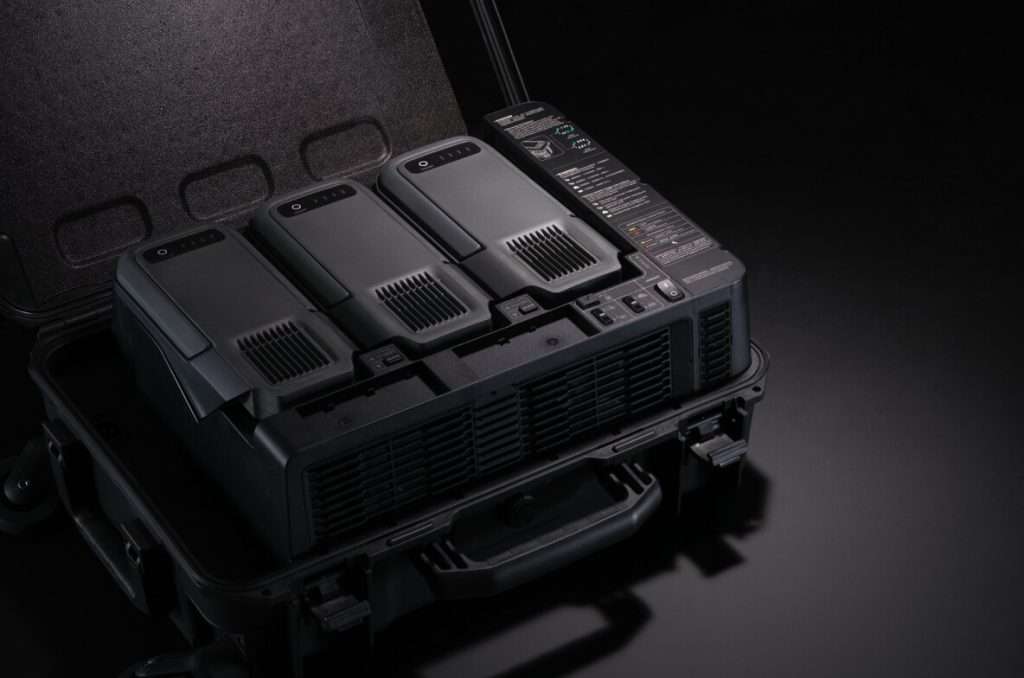
Battery Plan: Three TB100 Batteries
The M400’s published maximum flight time of up to 59 minutes is measured under DJI’s specified test conditions carrying the H30T. With the cleaning payload and hose, use approximately 30 minutes as a planning reference, subject to real operating conditions.
Recommended rotation:
- Battery in flight
- Battery charging
- Battery cooled, checked and on standby
This is the recommended alternative to electrical power tethering. Actual continuity depends on charging power, battery condition, temperature, flight profile and required reserve.
Which Option Should I Choose?
Choose A1 when:
You need the lowest-cost technical validation and accept a landing for manual nozzle replacement.
Choose A2 when:
You want the recommended commercial airborne workflow and already have—or plan to source—an approved ground pump locally.
Choose B when:
You want A2 plus a matched standalone Kärcher pump supplied by EAUAV.
Choose C when:
You want A2 plus the integrated white ground unit for a more organized water/detergent workflow.
Choose “Not sure” when:
You want EAUAV to review the building, water, power and pump information before recommending a configuration.
Information Needed for Quotation
- Country, city and postal code
- Company, buyer type and website
- DJI M400 ownership or local access
- Preferred option: A1, A2, B, C or Not sure
- Target surface, building height and project photos
- Water source and RO/DI or hot-water requirements
- Existing/local pump model and nameplate, if applicable
- Voltage, frequency, phase, plug and socket for Option B/C
- Required quantity and target delivery date
Compare the current M400 configurations and request a quotation.
Related Reading
- M400 Cleaning Kit Technical FAQ
- M400 Cleaning Payload: PSDK Workflow vs Separate Remote
- How High Can DJI M400 Clean Facades?
FAQ
Is A2 the same as the old “Gen-2 boom” name?
A2 is the current customer-facing name for the dual-nozzle airborne kit. Use A1 and A2 consistently. “Gen-2” remains only in the approved ground-system name: Gen-2 Integrated Ground System.
Does A2 automatically switch from detergent to clean water?
No. A2 selects the active spray head. Ground-side liquid switching is a separate function determined by the confirmed ground configuration.
Is the DJI M400 included?
No. The product is a cleaning-kit configuration for DJI Matrice 400. Aircraft, controller, batteries and charger are supplied separately unless listed in the quotation.
Is 120 m the guaranteed working height?
No. It is the standard hose length. Routine facade working-height planning is below 60 m, subject to site review and onsite validation.