When buyers look for an orchard spraying drone, they often compare the wrong things first. Tank size matters. Flow rate matters. But orchard work is rarely won by one headline number.
The real decision is whether the platform can handle a three-dimensional crop structure with enough control, visibility, and operational rhythm to make the workflow useful in real conditions. That is why orchard spraying conversations usually come back to three questions: what actually makes coverage difficult, why droplet control and canopy coverage must be judged together, and what really determines daily throughput in the field.
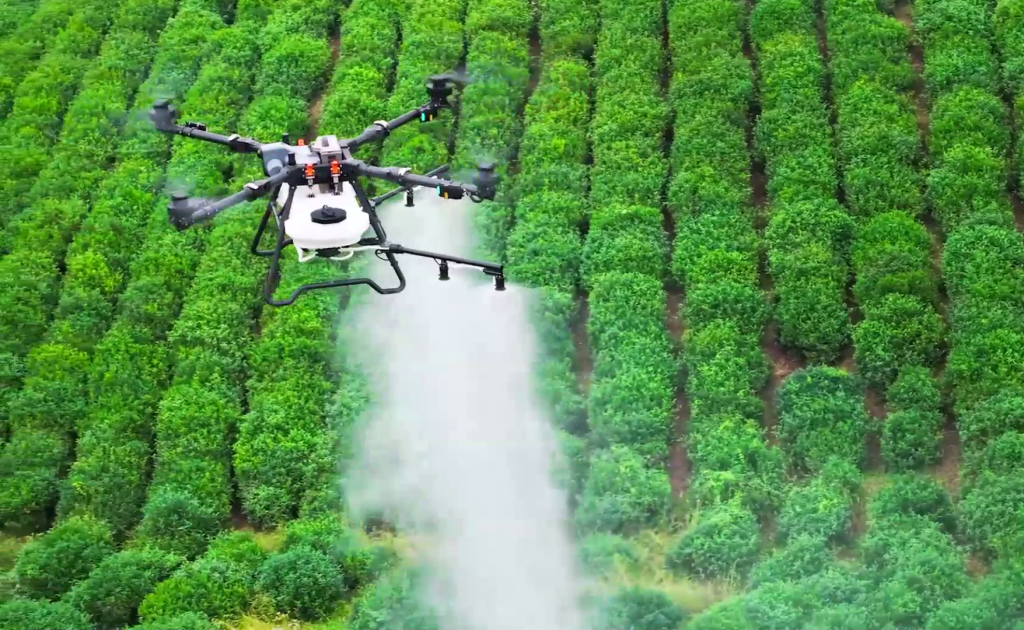
The A80 is a heavy-lift, modular agricultural drone platform built for spraying, fertilizer spreading, seeding, and precision payload delivery. For orchard use, its value is not in making canopy complexity disappear. Its value is in giving commercial users a more capable spray system, more setup flexibility, and a more robust field workflow when orchard conditions are demanding.
Why orchard spraying is different from broadacre spraying
Broadacre spraying is usually more open, flatter in target structure, and easier to plan in long, repeatable runs. Orchard spraying is different because the crop is vertical, layered, and uneven by nature.
A fruit tree spraying drone does not just pass over an open surface. It works around rows, gaps, headlands, sheltered pockets, denser canopy sections, and tree-to-tree variability. In many orchards, the target is not simply “the field.” It is a specific canopy zone, at a specific crop stage, under a limited working window.
That changes the buying logic.
In orchard rows spraying, a platform has to be judged on more than output. It has to be judged on how well it supports controlled application around real row geometry. A drone that looks strong on paper can still underperform if the spray setup is too rigid, if route efficiency collapses in short rows, or if visibility becomes unreliable near tree edges and low-light working windows.
The real meaning of canopy coverage
In orchards, canopy coverage does not simply mean that the outside of the trees looks wet. It means the spray is being placed across the canopy in a way that matches the actual agronomic target.
That is why “coverage” is a better question than “volume,” and why “canopy penetration” should never be treated as a fixed brochure claim. Canopy penetration is not one machine number. It is a field result shaped by canopy density, target position, row approach, droplet setup, and operating conditions.
A buyer searching for a canopy coverage drone is usually asking a practical question: can this system be tuned for real orchard conditions, or will it force one generic spray behavior onto every block?
That is the right question to ask before procurement.
Why canopy coverage and droplet control must be discussed together
Coverage and droplet control are inseparable in orchard work.
If droplet behavior does not match canopy density and target location, more volume does not solve the problem. It only delivers more liquid with the wrong behavior. Likewise, if droplet size can be adjusted but the platform cannot maintain stable delivery, the setup may still drift away from what the operator intended.
In other words, coverage is the result the buyer wants. Droplet control is one of the main levers that determines whether that result is realistic.
Droplet control: what changes when crop, target, and canopy density change
There is no single best spray droplet size for orchards.
Different crops, target zones, and canopy densities demand different spray behavior. A lighter, more open canopy does not ask the same thing from the spray system as a denser, more layered one. Early-season conditions do not behave the same as mid-season density. A target on the canopy exterior is not the same as a target deeper into the canopy.
That is why spray droplet size for orchards should be treated as a setup decision, not a fixed default.
The A80 supports 30–500 μm adjustable droplets, which gives operators a meaningful setup range rather than one locked spray pattern. For procurement teams, that matters because a droplet control agricultural drone should offer room to adapt the setup as crop architecture and application goals change.
This does not remove the need for on-site validation. Actual settings still need to be checked against orchard structure, local operating conditions, and the specific spray program. But a platform with real droplet adjustment gives the team more control before that validation even begins.
Why high flow alone is not enough
High flow is useful. It is not the whole answer.
In orchard spraying, buyers often focus on max flow because it feels like the fastest way to estimate productivity. But high flow alone does not guarantee good coverage, consistent canopy placement, or efficient daily output. If the route plan is poor, if droplet setup is mismatched, or if refill logistics are weak, a higher flow rate can simply turn mistakes into faster mistakes.
The A80 offers up to 40 L/min max spray flow rate, and that is valuable because it gives the system output headroom when the application plan requires it. But orchard performance comes from how that output is used, not from the number by itself.
The same applies to spray width. The A80 supports up to 10 m max spray width, which is useful as a system ceiling. In orchard work, however, the actual working width should be chosen around row spacing, canopy shape, and target consistency, not around the largest brochure figure.
For orchard buyers, the right conclusion is simple: high flow is a capacity tool. It is not a quality guarantee.
How A80’s spraying system supports orchard work
The A80’s orchard fit comes from how several spray-system elements work together rather than from any one feature on its own.
Capacity and refill rhythm
A 75 L spray tank gives crews more working headroom between refills. In orchards, that matters because daily rhythm is often broken less by flight itself than by interruptions: refill cycles, repositioning between blocks, and delays at awkward access points.
A larger tank does not make route efficiency irrelevant, but it does reduce how often the workflow has to stop and restart.
Combined with up to 40 L/min max spray flow rate, the A80 gives service teams a stronger basis for maintaining momentum on larger blocks or longer orchard days.
Droplet range and spray architecture
For orchard work, useful spray control is not just about adjusting droplets. It is also about how the liquid is delivered.
The A80 combines 30–500 μm adjustable droplets, up to 10 m max spray width, and four rear-mounted centrifugal nozzles. That matters because orchard setup is about creating a controlled spray pattern that fits row-based work, not just releasing liquid at speed.
The rear-mounted centrifugal nozzle layout gives operators a more deliberate spray architecture for orchard tasks. But again, actual canopy response should be validated on site rather than assumed from hardware alone.
Liquid stability and output consistency
One of the more overlooked orchard questions is whether the first refill and the last refill behave the same.
The A80 addresses this with dynamic circulation and mixing, backed by dual-channel metering pumps. EAUAV also specifies spraying accuracy deviation within 5%, which is relevant for buyers who care about repeatability across a full day rather than just the first few passes.
That combination helps the A80 feel less like a machine chasing peak numbers and more like a platform built for steadier commercial execution.
A practical buyer view looks like this:
| Orchard condition | Why it is difficult | What A80 feature matters | What should still be validated on-site |
|---|---|---|---|
| Dense or layered canopy | Outer canopy can intercept spray before inner target zones | 30–500 μm adjustable droplets, four rear-mounted centrifugal nozzles | Target zone, droplet setup, weather window |
| Irregular rows or short headlands | Turn frequency reduces route efficiency | 75 L tank, up to 40 L/min max spray flow rate | Actual working width, refill point layout |
| Uneven terrain or orchard edges | Height control and obstacle awareness become harder | LiDAR + mmWave phased-array radar, 360° LiDAR | Tree height variation, wire and obstacle map |
| Low-light working windows | Visibility pressure increases near trees and edges | Low-light full-color FPV, 80W bidirectional lights | Local operating SOPs, crew briefing |
| Long working days across multiple blocks | Throughput becomes a logistics question | 34Ah 18S high-voltage smart battery, multiple charging options | Battery rotation, power availability, transport between blocks |
Safety and visibility in orchard operations
Orchards are rarely simple flying environments.
Tree edges, uneven ground, poles, wires, changing headlands, and lower-light operating windows all create pressure on the pilot. A platform that looks capable in open space may feel very different when it is working near a dense orchard structure.
The A80 addresses that side of the job with LiDAR + mmWave phased-array radar, 360° LiDAR, and 850,000 pts/sec point clouds. It also includes low-light full-color FPV, 80W bidirectional lights, and a 7-inch HD remote controller.
These features do not replace site survey, route planning, or pilot judgment. But they do make the platform more credible for real orchard operations, where visibility and obstacle awareness are part of productivity, not separate from it.
A buyer should treat safety and visibility as production factors. If crews are uncomfortable at row ends, in marginal light, or around irregular edges, daily throughput will fall even if the spray system itself is strong.
What affects orchard spraying daily throughput in the field
Useful daily throughput is not theoretical area. It is completed, acceptable work over a real day, with real refill cycles, real turns, and real crew logistics.
Refill frequency
Refill rhythm is one of the biggest hidden drivers of orchard spraying daily throughput.
The 75 L tank helps reduce interruption frequency, but field performance still depends on where refill points sit, how nurse tanks are managed, and whether the liquid preparation workflow is disciplined enough to keep the aircraft moving.
Route efficiency
In orchard rows spraying, route efficiency is often more important than buyers expect.
Long, clean rows behave differently from fragmented blocks with short turns, obstacles, or uneven boundaries. Even a capable aircraft will lose effective output if route planning is constantly broken by awkward row transitions or repeated repositioning.
Terrain and row layout
Slopes, terraces, variable row spacing, and changes in tree height all affect how smoothly the day runs.
This is one reason orchard spraying should be planned as a site-specific workflow rather than as a generic drone task. The same aircraft can feel highly productive in one orchard and operationally constrained in another, purely because row layout changes the mission structure.
Light conditions
Early morning and late-day windows are common in orchard work. But those windows also change visibility demands.
The A80’s low-light full-color FPV and 80W bidirectional lights help here, especially when crews need confidence near row ends or edge trees. Still, light should be treated as an operational limit, not just a convenience feature.
Charging plan
Battery logistics can quietly decide whether a long orchard day stays efficient.
The A80 uses a 34Ah 18S high-voltage smart battery and supports three charging options: AC 12 kW, DC 12 kW, and integrated generator DC 11.5 kW. That does not tell the buyer field duration by itself, but it does show that orchard throughput depends on a planned charging strategy rather than guesswork.
For procurement teams, that is the right way to frame the question. Not “How much can the drone theoretically do?” but “How stable will the workflow remain after a full day of spraying, refilling, moving, and charging?”
When A80 is the right fit — and when a smaller platform may be enough
The A80 is the right fit when orchard work is demanding enough that capacity, setup flexibility, sensing, and logistics all need to be stronger than entry-level expectations.
That usually means larger orchard programs, denser or more variable canopies, longer working days, multi-block service routes, or commercial teams that need a higher-capacity spray workflow without losing control over droplet setup and field discipline.
A smaller platform may be enough when the orchard blocks are compact, canopy structure is less demanding, daily spray workload is moderate, or maneuverability and simpler deployment matter more than heavier-duty operating rhythm.
That is an important credibility point. The right answer is not automatically the biggest platform. The right answer is the platform that matches orchard geometry, spray objective, and team logistics with the least operational compromise.
Talk to EAUAV about your orchard workflow
If you are evaluating the A80 for orchard spraying, the most useful next step is not a generic brochure request. It is a workflow discussion.
Share the crop type, row spacing, canopy height range, target use case, block layout, working window, and your preferred field power setup. From there, EAUAV can help assess whether the A80 is the right orchard spraying platform for your operation, or whether a smaller system would be the more rational fit.
For commercial growers, ag service providers, distributors, and procurement teams, that is the conversation that turns a product comparison into a workable deployment plan.
FAQs
What is the best drone for orchard spraying?
There is no universal best drone for orchard spraying. The right choice depends on canopy density, row geometry, target zone, daily workload, crew structure, and field logistics. The A80 makes sense when buyers need heavier-duty spray capacity, broader droplet control, and a more robust operational workflow.
How does droplet size affect orchard spraying?
Droplet size affects how spray behaves around the canopy, including placement behavior, drift tendency, and whether the setup matches the target zone. That is why droplet choice should change with crop, target, and canopy density rather than staying fixed across every orchard.
Can an orchard spraying drone improve canopy coverage?
It can improve the operator’s ability to manage timing, repeatability, and setup control, which can support better canopy coverage. But actual coverage still depends on orchard structure, weather, route planning, and on-site validation.
What affects daily throughput in orchard drone operations?
Refill frequency, route efficiency, terrain, row layout, light conditions, battery rotation, and charging plan all shape real throughput. Useful throughput is completed acceptable work per day, not just a theoretical output number.
Is a high flow rate enough to judge orchard spray performance?
No. High flow helps capacity, but orchard performance also depends on droplet control, nozzle layout, liquid stability, target selection, and disciplined field execution.
When might a smaller orchard spraying drone be enough?
A smaller platform may be enough for compact blocks, simpler canopy structures, shorter working days, or lower daily spray volume. The decision should be based on real orchard demands, not on aircraft size alone.