No facade-access method wins every project. Drone cleaning can reduce the need to place a worker directly on a difficult exterior surface, but it is still a complete site operation involving a pilot, ground crew, water system, hose, exclusion zone and local flight compliance.
The right comparison is not “drone versus human.” It is: which method can produce the required result on this surface, at this site, with acceptable operational control?
Four Common Access Methods at a Glance
| Factor | Cleaning drone | Rope access | Boom lift / MEWP | Water-fed pole / ground manual |
|---|---|---|---|---|
| Worker at the facade | Usually no | Yes | Yes | Usually remains on ground at limited height |
| Surface contact | Primarily non-contact spray | Direct contact possible | Direct contact possible | Direct contact or close-range spray |
| Reach around recesses | Limited by geometry and spray line | Strong when anchors/access are suitable | Limited by machine reach | Limited by pole length and ground access |
| Ground footprint | Take-off area, pump, reel, hose and exclusion zone | Rope zone and anchor access | Large stable machine footprint and access route | Water equipment and working lane |
| Water/runoff control | Must be planned across spray path and ground zone | Can be localized by technician | Can be localized from basket | Often localized but height-limited |
| Wind sensitivity | Aircraft and suspended hose are wind-sensitive | Wind also affects suspended workers | Equipment-specific limits | Spray drift and pole control matter |
| Spot treatment | Limited without manual follow-up | Strong | Strong | Strong within reach |
| Mobilization | Can be efficient on suitable open facades | Requires anchor and rope setup | Requires delivery and machine positioning | Usually simple at accessible elevations |
| Regulatory dependency | Aviation plus worksite rules | Work-at-height rules | Equipment/operator and worksite rules | Worksite rules |
This table is a project-screening tool, not a universal cost or safety ranking. Local requirements, crew competence and site geometry determine the actual outcome.
Where Drone Facade Cleaning Is Strong
Drone cleaning is most attractive when the site has:
- A broad, relatively flat exterior surface
- Adequate open airspace and visibility
- A controllable take-off area and exclusion zone
- A clear hose route from the ground system
- Contamination that responds to non-contact foam, rinse or pressure spray
- A customer who can approve a low-height test before full deployment
For customers that already own or can source a DJI Matrice 400 locally, the EAUAV M400 Facade Cleaning Kit adds an airborne spray-boom workflow without purchasing a separate complete aircraft system.
Option A2 is the recommended commercial starting point. It lets the pilot select the active spray head from the DJI controller without landing solely to change the nozzle. This makes a foam-to-rinse workflow more fluid, but it does not change whether the underlying surface is suitable for non-contact cleaning.
Where Rope Access or a Boom Lift May Be Better
Direct-access methods can remain the better choice when the project needs:
- Scraping, brushing or close visual inspection
- Sealant, joint or localized repair work
- Detailed treatment around deep recesses and balconies
- Manual stain removal after a broad-area wash
- Work in airspace where drone operation is impractical or not permitted
- Precise containment that the proposed spray process cannot achieve
A boom lift also requires a suitable access route, stable ground and working envelope. Rope access requires appropriate anchorage, rescue planning and qualified technicians. These requirements should be compared with the drone operation rather than treated as invisible.
The Hybrid Workflow Is Often the Commercial Answer
Many professional projects combine methods:
- Use the drone for broad-area wetting, foam application and rinsing.
- Inspect the result using recorded imagery or a separate close inspection.
- Use rope access, a lift or manual tools only for stubborn spots and repairs.
This can reduce the amount of direct-access work without claiming that spray alone replaces every cleaning technique.
Ground Operations Still Determine Success
A facade-cleaning drone is connected to the ground by a high-pressure water hose. The crew must manage:
- Pump pressure and flow
- Hose routing, drag and fittings
- Water source and filtration
- Chemical compatibility and SDS requirements
- RO/DI final-rinse preparation when required
- Overspray and runoff
- Pedestrian and property exclusion zones
- Battery rotation and flight reserve
The standard M400 hose reference is 120 m, 5 mm internal diameter and rated to 20 MPa. That length is not a guaranteed vertical working height. For routine facade planning, use below 60 m as the initial M400 range, then validate the actual site.
Choosing the M400 Configuration
- Option A1: single-nozzle airborne kit and the lowest-entry-cost validation route; manual nozzle change requires landing.
- Option A2: recommended dual-nozzle airborne kit; the active spray head can be selected from the DJI controller.
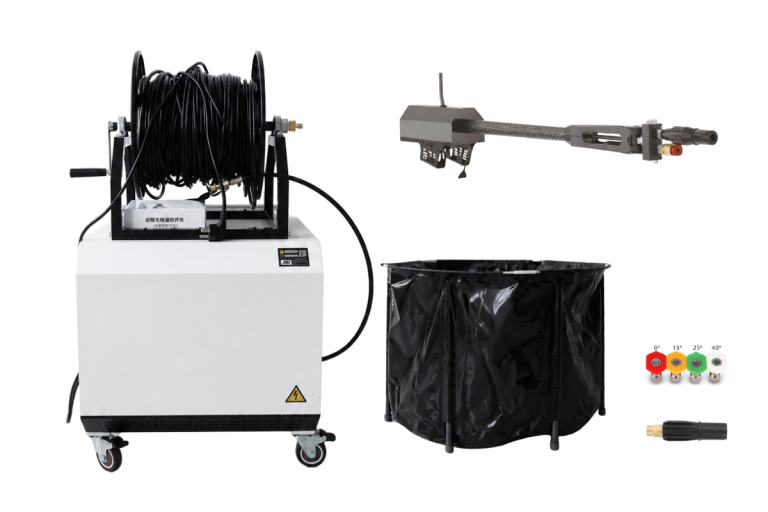
- Option B: A2 plus the Kärcher HD 6/15-4 M Classic standalone pump.
- Option C: A2 plus the white Gen-2 Integrated Ground System for a more integrated water/detergent workflow.
Customers may also use an existing or locally purchased pump after EAUAV engineering review. Initial screening requires at least approximately 3 kW, adjustable 12–18 MPa and approximately 450–600 L/h. Send the exact model, nameplate and outlet photos.
M400 Kit or Complete Cleaning Drone?
Choose the M400 kit path when local DJI Matrice 400 access, a modular payload and familiar DJI operation are central to the business case.
Compare the C80/C80P complete-system path when the customer prefers a dedicated cleaning platform or the project’s height, logistics and operating model fall outside the routine M400 plan. Current specifications and destination requirements should be confirmed at quotation.
Questions to Ask Before Comparing Prices
- What surface result is contractually required?
- Can non-contact spray achieve it without brushing?
- What is the building geometry and routine working height?
- Where will the pump, reel, aircraft and exclusion zone be placed?
- How will water, chemicals and runoff be controlled?
- Which approvals and qualified operators are required locally?
- Is manual spot treatment or repair included?
- What evidence will be used to accept the finished result?
These answers allow a fair comparison of the complete workflow—not merely the hourly rate of one piece of equipment.
Review the DJI M400 Facade Cleaning Kit or discuss a site-specific configuration with EAUAV.