Starting a facade cleaning drone service is not just an equipment purchase. It is a workflow-design project involving the aircraft, cleaning payload, ground pump, hose, water source, batteries, crew, site controls and local operating requirements.
For businesses that already own—or can purchase—a DJI Matrice 400 locally, the EAUAV M400 Facade Cleaning Kit provides a practical route into non-contact exterior cleaning. For most commercial operators, Option A2 is the recommended starting point because the pilot can select the active spray head from the DJI controller without landing solely to change the nozzle.
This guide explains how to build a workable first configuration and how to prepare for a controlled commercial trial.
Important: The cleaning kit does not include the DJI Matrice 400 aircraft, original DJI controller, TB100 batteries or BS100 charging station unless specifically stated in a quotation.
1. Define the First Service You Want to Sell
Begin with a narrow, repeatable application rather than trying to cover every exterior-cleaning task.
Good first-project candidates may include:
- Flat glass and curtain-wall facades
- Selected painted or coated exterior walls
- Routine rinsing where non-contact spray is appropriate
- Buildings with a controllable ground exclusion area
- Sites with practical access to water, power and hose routing
Record the building height, surface material, contamination, access constraints, water source, runoff requirements and expected cleaning result. A small low-height test area should be validated before scaling to a complete facade.
For routine M400 facade planning, EAUAV uses a working-height reference below 60 m, subject to site review and onsite testing. The standard 120 m hose length must not be interpreted as a guaranteed 120 m vertical working height.
2. Choose the Airborne Kit First: A1 or A2
Option A1 — Lower-Cost Technical Validation
Option A1 uses a single-nozzle spray boom. It is appropriate for a customer who wants the lowest entry cost or a straightforward water-only task.
For a foam-to-rinse process, the aircraft applies foam, lands, the crew manually changes the nozzle, and the aircraft takes off again for the rinse cycle.
Option A2 — Recommended Commercial Starting Point
Option A2 uses a dual-nozzle spray boom. The pilot can select the active spray head through the DJI controller, so the aircraft does not need to land solely for a nozzle change.
A typical workflow is:
- Apply foam or cleaning solution using the selected spray head.
- Switch the active spray head from the DJI controller.
- Continue with the pressure-rinse head without a nozzle-change landing.
The controller changes the active spray head. It does not automatically change the liquid supplied from the ground. Water, detergent and mixed-mode switching depend on the chosen ground configuration and must be confirmed separately.
For service companies expecting repeated foam-to-rinse jobs, A2 normally delivers the more fluent and professional workflow.
3. Select the Ground-Pump Route
After selecting the airborne kit, choose one of three ground-system paths.
Use an Existing or Locally Purchased Pump
This route can reduce freight and simplify local maintenance. As an initial screening baseline, the pump should provide:
- At least approximately 3 kW
- Adjustable pressure in the 12–18 MPa range
- Approximately 450–600 L/h flow
Before compatibility is confirmed, send EAUAV the exact pump model, a clear nameplate photo and photos of the water outlet and fittings. EAUAV engineering will review the pump, hose connection and intended working conditions. Meeting only the headline numbers does not automatically confirm compatibility.
Option B — A2 + Matched Standalone Pump
Option B adds a Kärcher HD 6/15-4 M Classic to Option A2. The reference pump provides adjustable pressure up to 150 bar, approximately 450–600 L/h flow and 3.4 kW rated input.
This is the simpler EAUAV-supplied ground-pump route. It is suitable for customers who need a matched professional pump but do not need the integrated water-and-detergent workflow of Option C.
Before quotation, confirm the destination voltage, frequency, phase, plug type and socket type.
Option C — A2 + Gen-2 Integrated Ground System
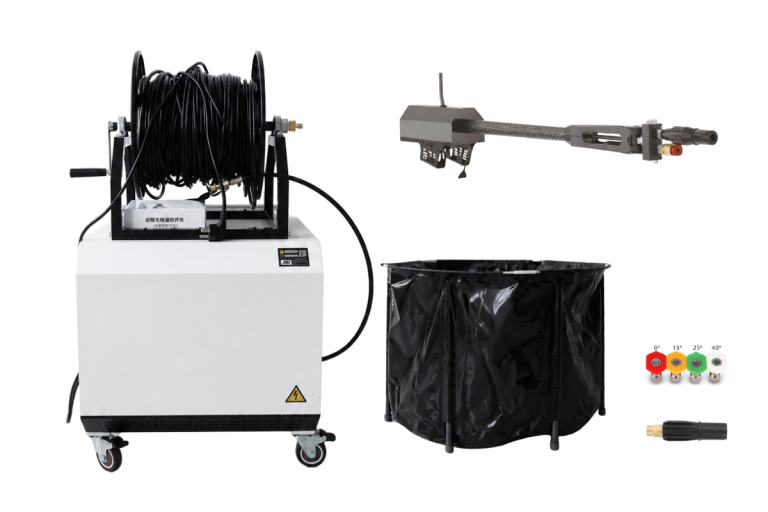
Option C adds the white Gen-2 Integrated Ground System to Option A2. It combines the pump, mobile platform, hose-reel connection and water/detergent workflow in one ground unit.
Current reference configuration:
- Up to 15 MPa
- Up to 11 L/min
- Approximately 3.3 kW
- 300 L foldable water tank
- 10 L detergent tank
- Integrated reel and remote start
- Water and mixed-mode ground workflow
Option C is designed for teams that want faster, more organized jobsite setup. It does not produce RO/DI water or hot water.
4. Plan the Hose, Water and Rinse Process
The standard hose reference is 120 m long, 5 mm internal diameter and rated to 20 MPa. Hose routing affects the aircraft through suspended mass, drag, bends and changing wind exposure. Test the system at low height before increasing the working envelope.
Begin facade testing at approximately 1.5 m stand-off distance from a flat surface, then adjust pressure, nozzle, angle and distance according to the substrate and observed result.
The customer should prepare the clean-water supply. When spot-free final rinsing is required, the customer must also prepare suitable RO/DI water-treatment equipment. If hot-water treatment is required, compatible hot-water equipment is also customer-prepared. EAUAV does not currently offer a self-developed and validated RO/DI or hot-water preparation system.
5. Prepare Three TB100 Batteries for Rotation
The DJI Matrice 400 has a published maximum flight time of up to 59 minutes under DJI’s specified test conditions carrying the H30T. This figure does not represent cleaning operation with the spray boom and water hose.
With the cleaning payload, hose and operating conditions, use approximately 30 minutes per cleaning flight as a planning reference, then validate the actual duration onsite.
EAUAV recommends three TB100 batteries rotating through:
- Flight — installed in the aircraft
- Charging — recovering for the next cycle
- Standby — cooled, checked and ready for exchange
Actual continuity depends on charging power, ambient temperature, battery condition, flight profile, hose load and mandatory reserve. The three-battery plan supports a practical rotation; it is not a promise of uninterrupted operation.
6. Build a Small, Disciplined Crew
A first commercial crew should assign clear responsibilities:
- Remote pilot: aircraft control, flight path and controller functions
- Ground-system operator: water, pump, pressure, liquid mode and emergency shutdown
- Spotter/site-safety lead: hose route, exclusion zone, people, obstacles and changing conditions
Local regulations may require different roles or additional personnel. The team should rehearse normal launch, low-height spray testing, battery exchange, pump shutdown and emergency procedures before a customer demonstration.
7. Run a Controlled Demonstration
Do not use the first customer project as the first complete system test. Create a demonstration plan with a clear pass/fail checklist:
- Mounting and controller functions verified
- Pump compatibility confirmed
- Hose and fittings pressure-tested
- Low-height hover and hose response checked
- Spray pattern validated at approximately 1.5 m starting distance
- Surface compatibility checked on a small area
- Water runoff and exclusion zone controlled
- Battery rotation timed under real conditions
- Before/after footage recorded consistently
For A1, demonstrate the foam flight, landing, manual nozzle change and rinse flight. For A2, demonstrate controller selection of the second spray head without landing solely for that change.
8. Price the Service from Measured Inputs
Avoid promising a fixed square-metre production rate before field testing. Build quotations from:
- Mobilization and site setup
- Building geometry and working height
- Surface condition and required result
- Water and chemical preparation
- Flight and battery cycles
- Crew and exclusion-zone requirements
- Access-method backup or manual finishing
- Local permits, insurance and risk controls
The correct commercial metric is not simply drone flight speed. It is the complete time and cost required to deliver the agreed cleaning result safely and repeatably.
Information Needed for an M400 Configuration Quote
To receive a useful recommendation, provide:
- Country, city and postal code
- Buyer type and company website
- Whether you own or can source a DJI Matrice 400 locally
- Preferred option: A1, A2, B, C or “Not sure”
- Target surface and contamination
- Approximate building height and project photos/video
- Available water source and whether RO/DI final rinse is needed
- Existing/local pump model, nameplate and outlet photos, if applicable
- Destination voltage, frequency, phase, plug and socket type for Option B or C
- Expected order quantity and target project date
Recommended First Configuration
For most new commercial facade-cleaning operators who already have local access to a DJI Matrice 400, start by evaluating Option A2. Add Option B when you need a matched standalone pump, or Option C when you need the integrated white ground system and detergent workflow.
Review the DJI M400 Facade Cleaning Kit and request configuration guidance.